
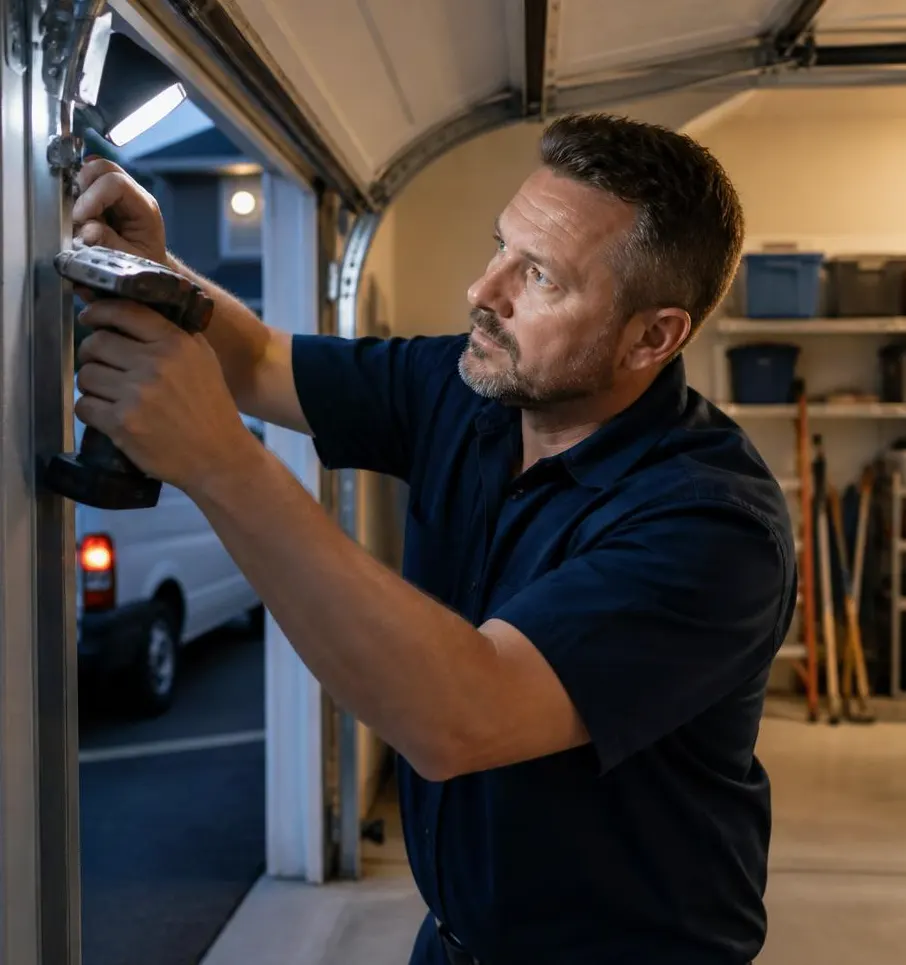
What a technician sees on a typical call
The call usually starts the same way: one person thinks the door just needs a quick touch-up, the other thinks it's time to buy a new one. The technician gets out of the truck, walks up to the door, and looks at exactly one spot first — the bottom 6 to 12 inches of the panels. That's where it's happening. Bubbled paint. A rust stain bleeding out from under the bottom weatherstrip. On older wood-composite doors, a soft, swollen edge that doesn't quite meet the frame anymore. On steel doors, little pinhead-sized rust spots along the seams where water sits after a storm.
None of this is random. It's what happens to a garage door that spends half the year dealing with afternoon downpours, high humidity, and long stretches where the air never really dries out between storms.
Why this climate is hard on garage doors
Steel doors are coated to resist corrosion, but that coating is only as good as the paint and sealant on top of it. Every time water sits against the bottom panel — from rain blowing in, splashback off the driveway, or a sprinkler hitting the door — it starts working on any tiny scratch or chip in that coating. Add hurricane-season humidity and the metal never fully dries, so rust gets a head start it wouldn't get in a drier climate.
Wood and wood-composite doors have the opposite problem: they swell. Moisture soaks into the bottom rail, the door gets heavier and tighter in the frame, and over a few humid seasons the wood can start to delaminate or warp slightly out of square. That's usually when one spouse says "it's just sticking a little" and the other says "the door doesn't close right anymore." Both are describing the same moisture problem at different stages.
How to tell cosmetic damage from a real problem
This is the part that actually settles the argument, because rust and swelling aren't one thing — they're three different situations with three different answers.
- Surface rust: Small orange spots or a thin rust line, paint intact around it, no flaking when you scratch it with a fingernail. This is cosmetic. It can be sanded, primed, and repainted in an afternoon.
- Flaking or bubbling rust: Paint that lifts off in chips, rust that crumbles or leaves a hole when you press on it, or a panel that flexes more than the others when you push on it. This means moisture has gotten under the coating and is eating the metal itself. It won't get better with paint — it needs the panel assessed, and possibly replaced, before it spreads.
- Swollen wood or composite: The door doesn't sit flush, drags on the track, or looks warped at the bottom corner. Try closing the door on a dry day and see if it seats normally — if it still binds, the swelling has gone past surface-level and into the panel structure.
A simple test: run your hand along the bottom panel. If it feels solid and the rust is only on the surface, you're in touch-up territory. If it feels soft, flaky, or spongy anywhere, that's a structural conversation, not a paint conversation.
What actually slows this down
You can't change the weather, but you can change how much of it sits on the door.
- Clear the weep holes. Steel doors have small drainage holes along the bottom track — if they're clogged with dirt or old caulk, water pools instead of draining.
- Touch up chips early. A $10 can of matching touch-up paint on a fresh scratch is a lot cheaper than a replacement panel six months later.
- Check and replace the bottom weatherstrip seal. A cracked or flattened seal lets rain blow straight in during the heavier afternoon storms. This is a quick fix and one of the most overlooked ones.
- Keep gutters and grading pointed away from the door. If water runs toward the garage instead of away from it, no amount of paint will keep up.
- Lubricate hinges, rollers, and springs a couple times a year. Humid air rusts hardware just as fast as panels, and a stiff, rusted hinge puts uneven stress on the whole door.
- Let the garage breathe. If the space is sealed tight with no airflow, humidity gets trapped against the inside of the door too.
When to call Mt Olive Garage Door
If you've checked the panel and it's soft, flaking, or the door isn't sitting flush in the frame, that's the point to stop debating and get it looked at. We handle this two ways depending on what we find: for hardware that's rusted stiff or springs that are pitted and weakened by moisture, our Spring Replacement service gets the door back to moving smoothly and safely. For panels, seals, and track issues caused by water intrusion, our Garage Door Repair techs can tell you on the spot whether it's a patch-and-paint job or a panel that needs replacing — no guessing required.
If you're in Mt Olive, Gardendale, Kimberly, Warrior, Morris, Fultondale, Center Point, or Trafford and you want a straight answer instead of a guess, give Mt Olive Garage Door a call. We'll tell you exactly what we're looking at and what it actually needs — nothing more, nothing less.